
Commission on Teacher Credentialing
2025 Annual Report
To our valued partners,
We are pleased to present you with the 2025 Annual Report for the California Commission on Teacher Credentialing related to our responsibilities as the state standards board for educator preparation, licensure, professional practice, and discipline.
Driven by a strategic plan centered on equity, inclusion, and diversity in the classroom, our work plays a pivotal role in ensuring that California’s nearly six million students benefit from well-prepared, diverse, and effective educators who foster inclusive learning environments and drive academic success.
As you’ll read below, the Commission’s achievements in 2025 focused on completing substantial multi-year initiatives, updating critical components of the educator preparation and licensure system, and improving the quality, consistency, and accessibility of our services.
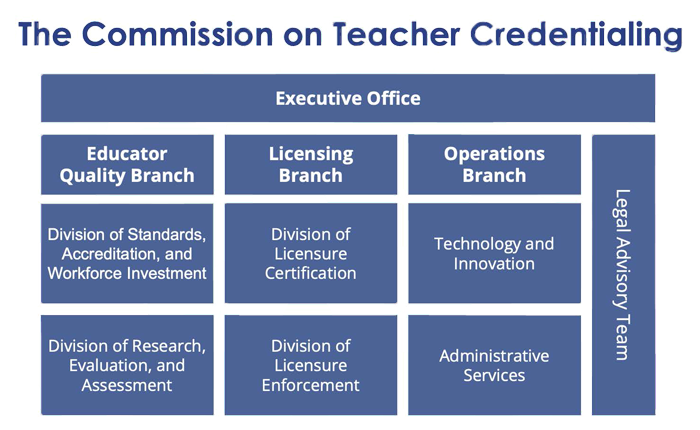
This includes a new organizational structure that strengthens the coherence and effectiveness of our work across the agency with the establishment of three new branches: Licensing, Educator Quality, and Operations. This structure, depicted below, brings together divisions with related responsibilities, improves communication and coordination across the agency, and enhances the Commission’s capacity to respond to emerging needs in the educator workforce system.
The progress achieved in 2025 provides a strong foundation for several major initiatives scheduled for 2026 through 2028, including:
- Implementation of the three-year continuous improvement plan for teaching performance assessments and the accreditation system required by Senate Bill 1263 (Newman)
- Continuation of the statewide refresh of teacher licensing examinations
- Continued work on updating and aligning standards for teacher subject matter competence with state adopted PK-12 standards and framework
- Finalization of Child Development Permit specializations
- Expansion of PK-3 ECE Specialist credential programs
- Further modernization of licensing and data systems
A new statewide Student Teacher Stipend Program aiming to strengthen California’s teacher workforce will provide needed financial support to student teachers completing the classroom hours required for credentialing.
The stipend program, established in Assembly Bill 121, will launch in the 2026-27 academic year and provide funding to local educational agencies for stipends of $10,000 to be paid to student teachers completing their clinical practice.
The state has allocated $300 million for the student teacher stipends in fiscal year 2025-26. Funding distribution will begin on July 1, 2026, at $100 million per year for three years, and then annually as available.
Acceptance of online applications for the Student Teacher Stipend Program begins on July 1, 2026.
The bill also provides $30 million for the National Board for Professional Teaching Standards Certification Incentive Program and for covering fees. Administrative duties of the program will be transferred July 1, 2027, to the Commission from the California Department of Education.
The Commission appreciates the state’s continued investments in programs and initiatives that help ease the teacher shortage and make earning a credential more affordable. We extend our gratitude for the support of the Legislature, the Newsom Administration, and our many partners who join a collective commitment to continuously improve educator excellence for California’s students.
Sincerely,
Marquita Grenot-Scheyer
Chair
Mary Vixie Sandy
Executive Director

Processed 328,732 applications (2024-25)

Issued 17,426 preliminary teaching credentials, 59 of them PK-3 credentials (2023-24)

Opened 5,625 educator misconduct cases, action taken on 794 (2024-25)

Approved 10 new institutions to offer educator preparation programs. Approved 36 new preparation programs (2024-25)

Awarded grants to 61 grantees and continued oversight of nearly 700 grants (2024-25)

Education career counselors responded to 4,160 inquires (2024-25)

Literacy and Reading Instruction Standards
The Commission on Teacher Credentialing reached significant milestones toward California’s efforts to change how reading is taught and to ensure that teacher candidates can demonstrate high-quality literacy instruction.
Senate Bill 488 (Chapter 678, Statutes of 2021) called for new literacy and reading standards for the preparation of teacher candidates and their corresponding Teaching Performance Expectations (TPEs).
Additionally, the bill required the Commission to review teacher preparation programs and certify that they are providing instruction in the updated standards and TPEs, as well as to develop a new literacy performance assessment (LPA) to replace the 25-year-old Reading Instruction Competence Assessment (RICA).
In 2025: Commission staff completed the literacy program certification process for teacher preparation programs. Reviews were conducted for 95 institutions offering 229 educator preparation programs and 520 pathways with 99% certified as meeting the updated literacy standards.
In parallel, the Commission implemented the new LPA and updated all approved teaching performance assessments to include literacy components for use beginning in the 2025-26 academic year.
California teacher candidates must demonstrate their ability to effectively teach literacy by completing a certified teacher education preparation program and passing either the California Teaching Performance Assessment (CalTPA), the Educative Teaching Performance Assessment (edTPA) or the Fresno Assessment of Student Teachers (FAST), all of which include an approved LPA, before they can earn a preliminary teaching credential.
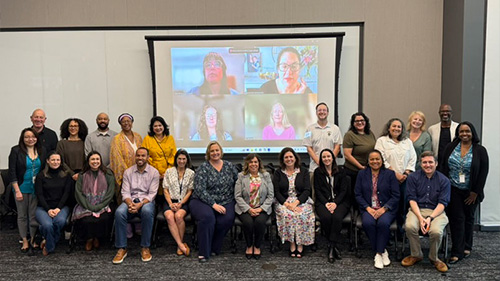
RDI-TPA workgroup members
Performance Assessment Improvements
The Teaching Performance Assessment (TPA) is California’s only remaining required measure of whether a prospective teacher is ready to instruct prior to earning a credential. Additionally, TPAs serve as a valuable tool to evaluate teacher preparation programs.
The Commission is committed to reviewing and updating TPAs as well as working to support teacher preparation program improvement that maintains the quality and effectiveness of new teachers.
Last year, the Commission selected a broadly representative team of educators, faculty and TPA experts for the Workgroup to Review the Design and Implementation of the Teaching Performance Assessments (RDI-TPA) in alignment with Senate Bill 1263 and Commission direction.
In 2025: The RDI-TPA workgroup completed its review of the design and implementation of TPAs resulting in a three-year implementation plan adopted by the Commission.
Workgroup recommendations are aligned with areas specified in statute, including modifications to TPAs, recommendations for embedding the TPA into coursework and clinical practice, and recommendations for strengthening accreditation to support embedding.
Specific actions included the update of CalTPA and California Administrator Performance Assessment (CalAPA) materials released in 2025-26, revised condition codes to reduce resubmissions caused by technical issues or missing content, and revised guidance on the necessary and appropriate level of support that programs are expected to provide to candidates completing a performance assessment.
Additionally, our new Division of Research, Evaluation and Assessment, established early in 2025, continued development of a multiple measures dashboard that will allow the Commission to monitor performance across programs and identify those requiring technical assistance.
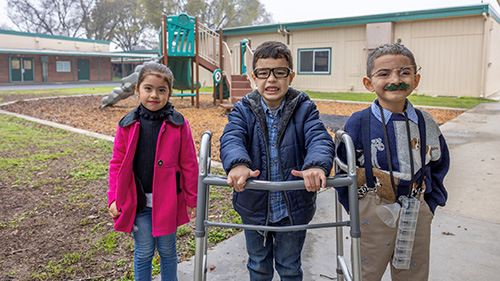
Houston Elementary students in Visalia Unified School District participate in the “100 Days in School” engagement event.
Teaching Standards
Our revised California Standards for the Teaching Profession (CSTP), adopted in 2024, establish a foundation for teacher preparation and teacher induction. The standards are focused on supporting new teacher practice to enhance inclusive student achievement, social and emotional well-being, and highlight enhanced family and community engagement practices.
In 2025: The updated CSTP were implemented in induction programs, supported by the revised Continuum of Teaching Practice, a tool for use within teacher induction and to guide teacher preparation program sponsors as they transition to implement the revised CSTP.
The updated standards are organized within the following six domains that embed California’s vision for teaching in an equitable, effective learning system:
- Engaging and supporting all students in learning
- Creating and maintaining effective environments for student learning
- Understanding and organizing subject matter for student learning
- Planning instruction and designing learning experiences for all students
- Assessing students for learning
- Developing as a professional educator
All Commission-approved induction programs have been expected to transition fully to the updated standards by 2026.

Spanish Bilingual Teacher Residency Program in Madera on a cohort cultural exchange experience in Oaxaca, Mexico.
Workforce Investments
The 2025-26 state budget includes $464 million for teacher workforce investments to continue three programs and add a new one that provides candidates seeking teaching credentials $10,000 stipends for student teaching. The budget includes:
- $300 million in new funding for student teacher stipends
- $70 million to extend the Teacher Residency Program
- $64 million to extend the Golden State Teacher Grant program, administered by the California Student Aid Commission, which offers college tuition for those who agree to teach in hard-to-staff subjects or underserved districts
- $30 million to extend the National Board Certification program, which offers a professional learning community, pathways to leadership, and tools to deepen teachers’ impact. Administration of this program will move from the California Department of Education to the Commission on Teacher Credentialing in 2027.

Supporting Teacher Recruitment
In California’s diverse and dynamic education landscape, our efforts are increasingly urgent to support teacher recruitment, remove barriers, and increase access to the profession.
Two key pieces of legislation added options for educator credential program applicants to meet the Basic Skills Requirement (BSR) and the Subject Matter Requirement (SMR) for earning a credential: Assembly Bill 130 in 2021 allowed candidates to meet the SMR through qualifying coursework and Senate Bill 153 in 2024 further broadened pathways by allowing a candidate’s credential-related bachelor’s degree to satisfy the BSR for most credentials.
As a result, teacher candidates in California are increasingly selecting college coursework and degrees over examinations as methods to demonstrate the knowledge, skills, and abilities required to enter the profession.
In 2025: The Commission approved staff to move forward in 2026 with a plan to evaluate all current examinations and ensure they reflect current standards and expectations. Exams being evaluated include the California Subject Examinations for Teachers (CSET), California Basic Educational Skills Test (CBEST), Early Completion Option Examinations for Interns and the California Teacher of English Learners Exam (CTEL).
The goal is to create a system that supports multiple ways to demonstrate competency by integrating options such as coursework, degree programs, and performance assessments, as valid methods to demonstrate competency to enter the teaching profession.
Commission staff also advanced work to streamline and improve options for meeting the SMRs for teaching credentials to align with current state standards and support transcript review by educator preparation programs.
 Monica Dekat, Education Specialist, Fortuna Middle School, and former resident with the Humboldt County Office of Education.
Supporting Teacher Recruitment
The Commission administers state-funded grant programs that expand pathways to credentialing, support high-quality teacher preparation, and increase diversity of the education workforce.
The impact of Commission-facilitated grant programs is far reaching. For example, the Teacher Residency Grant Program expands, strengthens, improves access to, and/or creates teacher residency programs, and the Statewide Residency Technical Assistance Center provides support for developing and implementing teacher and school counselor residency programs.
In 2025: The Commission completed distribution of more than $500 million in teacher residency grant funding allocated in the 2021 and 2022 state budgets. These awards included $481 million in Teacher Residency Implementation and Expansion Grants intended to support residents who will be hired in shortage areas, and $25 million in funding for Teacher Residency Capacity Grants awarded to LEAs that plan to design or expand a residency program.
Commission staff continued oversight of 696 active grants across nine programs and facilitated awards to a total of 61 grantees across five state-funded grant programs that include: Teacher Residency Grant Program, School Counselor Residency, Classified School Employee Teacher Credentialing, Computer Science Supplementary Authorization Incentive, and Mathematics Instruction Added Authorization and Reading and Literacy Supplementary Authorization Incentive.
The Classified School Employee Teacher Credentialing grant, expanded with $125 million in the 2021-22 state budget, experienced significant growth in the 2024-25 academic year with 4063 total participants and 523 who completed the program and earned a preliminary teaching credential.
Also successful is the Integrated Undergraduate Teacher Preparation grant funded with $20 million in the 2022-23 state budget. In 2024-25, 115 candidates earned their undergraduate degree and preliminary credential in the second year of the grant program.
Over 70% of participants in residency, classified, and integrated grant programs identify as candidates of color, reflecting strong progress toward equity goals.

Early Childhood Education
A well-prepared early childhood education (ECE) workforce is essential for high quality preschool programs and improved outcomes for young children. In alignment with California’s Master Plan for Early Learning and Care and in support of Universal Transitional Kindergarten, we are working to attract and retain a diverse early learning and care workforce that has a deep understanding of child development.
In 2025: The Commission adopted a revised Child Development Permit (CDP) matrix that outlines the care and instruction of children ages zero to eight. The matrix is a lattice of stability and ladder of opportunity for the ECE workforce with five CDP educator and administrator levels that align with the National Association for the Education of Young Children Standards and Competencies.
The Child Development Permit workgroup developed updated performance expectations, conducted a field survey, and drafted recommendations for areas of specialization that address the needs of multilingual learners, infants and toddlers, and school-age children in expanded learning programs. Staff expect to return in 2026 with further analysis and options related to areas of specialization.
The Commission continued approval of PK-3 ECE Specialist programs totaling 16 statewide with 18 more in the queue for review and six institutions expressing interest in developing a program, as of Feb. 11, 2026. The PK-3 credential focuses on the development and unique needs of young children and aims to expand a diverse workforce of educators who have the necessary knowledge, skills, and abilities to provide developmentally appropriate learning. A total of 513 PK-3 credentials have been issued to date.

Center for Educator Workforce Development
In 2025: The Commission launched its new Center for Educator Workforce Development to strengthen how California recruits, prepares, and retains professional educators.
The Center’s imperatives include advancing smarter uses of data, strengthening cross-agency collaboration, and innovating in pathways to teaching. In the coming year, the Center will reconvene the State Educator Workforce Collaborative, bringing together agencies to tackle shared challenges around retention, equity, and preparation pathways.
Its first major initiative focuses on developing registered apprenticeship programs for prospective teachers that provide hands-on training while candidates earn their credentials.
The Center for Educator Workforce Development is housed in the Division of Research, Evaluation, and Assessment with initial funding from the Bill & Melinda Gates Foundation. While current priorities reflect early grant-funded work, the Center is designed to grow with the needs of the field—responsive to data, informed by practitioners, and rooted in partnership. Learn more on the Center’s newly launched website.

Technology, Data, and Service Improvements
In 2025: Staff continued to refine and modernize the Commission’s data collection and reporting systems. Additional credential types were added to the CTC Online system as work continued toward full paperless processing. The Division of Research, Evaluation and Assessment expanded its role in managing assessment and workforce data, and new data dashboards were developed to support performance assessment monitoring, accreditation decision-making, and assignment reporting.
Work also continued on integrating grant, performance assessment, and program information to support research, policy development, and continuous improvement. The Division of Licensing Enforcement automated several high-volume processes while staff strengthened communication and customer service pathways through a new help system, improved reporting tools, and expanded access to guidance materials.
These efforts collectively strengthened the preparation and licensure system and advanced the Commission’s broader goals related to educator quality, workforce access, and continuous improvement.

Administrative Services Credential Update
Assembly Bill 1454 (Rivas, Muratsuchi, Rubio) requires that by Sept. 1, 2028, the Commission ensure that the standards for Administrative Services Credential (ASC) programs include preparation on how to support teachers in delivering instruction through effective means for teaching literacy. In addition, Gov. Gavin Newsom included in his veto message for AB 2725 in 2024, a request that the Commission develop two pathways to the ASC: one for teachers and one for other credential holders.
In 2025: The Commission adopted a workplan and schedule to update the Administrative Services Credential requirements and program standards. Revisions to the credential structure will include a teaching and a non-teaching path to an administrative services credential. Updates to the standards and performance assessment will begin in 2026 with a focus on strengthening leadership preparation, performance expectations, and pathways.
SPECIAL THANKS!
Commission on Teacher Credentialing
651 Bannon Street
Sacramento, CA 95811